Posted by Joe Delaney on 16th May 2025
Organic vape juice is e-liquid made from ingredients grown and certified to organic standards, and in the UK it is much rarer than the label suggests. Very few e-liquids carry real organic certification, so the useful question is what an e-liquid contains, not what it calls itself. This guide explains what organic means, why it is rarely certified, and what to look for instead.
By Joe Delaney, Director and Content Writer at V2 Cigs UK
Originally published: 16th May 2025 | Last updated: 20th November 2026
Vaping products are for adult smokers and existing vapers only. Vaping is not risk-free. Not suitable for non-smokers or anyone under 18.

What Does Organic Mean for Vape Juice?
In the UK, "organic" is a protected word for food and farm products. Anything sold as organic has to be produced to organic standards and checked by an approved control body such as the Soil Association, and the label has to carry that body's code (GOV.UK: organic food labelling rules; approved UK control bodies).
E-liquid isn't food, so those rules don't map neatly onto it. For a vape juice to be organic in any meaningful sense, its main ingredients would need to come from certified organic crops, and someone would need to certify the finished liquid. That is the part most "organic" e-liquids skip.
When people search for organic vape juice, they usually mean one of three things: an e-liquid with fewer ingredients, one without propylene glycol (PG), or one whose ingredients come from plants rather than a lab. All three can be checked, and none of them needs an organic badge.
Why Is Certified-Organic E-Liquid So Rare?
Most of what goes into a bottle can't easily be certified. A typical e-liquid has four parts: vegetable glycerine (VG), propylene glycol (PG), flavourings and, in most bottles, nicotine.
- VG is made from plant oils such as soy, palm or coconut. It can come from organic crops, but the finished glycerine still needs certifying.
- PG is made synthetically, so it can't be organic at all.
- Flavourings are often blends of many compounds, natural and synthetic, which makes certification hard.
- Nicotine is extracted from tobacco leaf or made synthetically. Certified-organic nicotine is very hard to find.
So an e-liquid can be 100% VG and PG-free without being organic, and that is the honest position on our shelves too. None of the e-liquids we stock are sold as certified organic. What we can tell you is exactly what is in each one.
Is There Such a Thing as Organic Nicotine?
Not in any form you're likely to find on a UK shelf. "Organic nicotine vape" is one of the most common searches that lands on this page, and the answer is that nicotine in e-liquid is either extracted from tobacco leaf and purified, or made in a lab as synthetic nicotine. Neither route normally comes with organic certification.
What you can rely on is how much nicotine is in the bottle. UK e-liquids are limited to 20mg/ml and must state the strength on the label, so a 10ml nic salt at 10mg or 20mg says exactly what it contains. If nicotine source matters to you, the product page or the manufacturer is the place to ask, not a front-of-bottle claim.
What to Look For Instead of an Organic Label
Four things tell you far more than the word organic.
1. The VG and PG ratio. Every bottle states it. A 100% VG e-liquid contains no PG, which is what many people searching for natural vape juice are really after. VG is thicker and sweeter-tasting, and it produces more vapour. Our guide to VG and PG explains how the ratio changes the vape.
2. PG-free on the label. If you've found PG doesn't suit you, look for "PG-free" or "100% VG" rather than "organic". The two often get mixed up, but only one of them tells you what's in the bottle.
3. Naturally derived ingredients. Plant-based VG and named flavour sources are worth looking for. Be wary of "natural" used on its own with no detail behind it; it has no fixed legal meaning on an e-liquid.
4. A full ingredient list. UK rules require nicotine e-liquids to be notified to the MHRA with their full ingredients before they go on sale, and the pack has to list them (MHRA: ingredient guidance for e-liquids). A brand that is open about every ingredient is giving you more than a badge ever could.
Where 100% VG E-Liquid Fits

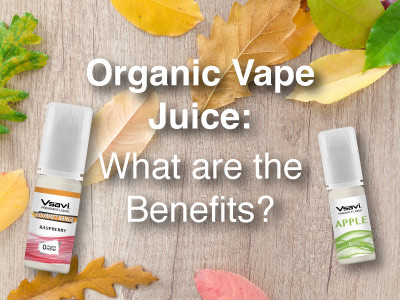
If what you want is a short ingredient list and no PG, a 100% VG e-liquid is the closest match. Our 100% VG e-liquid range from Vsavi is made with plant-based VG, comes in tobacco, menthol, fruit and gourmet flavours, and lists its ingredients in full.
One thing to know before you buy: 100% VG is thick. It works best in a sub-ohm device with a coil of around 0.6 ohm or lower, where the wick can soak it up properly. In a small, high-resistance mouth-to-lung pod it can starve the coil and taste burnt. Customers ask us about this more than anything else on the range, and it's usually the device, not the liquid. If you're not sure your kit will cope, our vape kits list the coil resistance on every product page.
Frequently Asked Questions
Is PG-free the same as organic?
No. PG-free means the e-liquid contains no propylene glycol, usually because it is 100% VG. Organic would mean the ingredients were grown and certified to organic standards. An e-liquid can be PG-free without being organic.
What does natural flavouring mean on vape juice?
It usually means the flavour compounds were taken from a natural source rather than made synthetically. There is no single standard behind the phrase on e-liquid, so the ingredient list and the brand's own information are a better guide.
Can I use 100% VG in a pod kit?
Sometimes. Pods with lower-resistance mesh coils can handle it; small pods with coils above 1 ohm usually struggle and may taste burnt. Check the coil resistance first, or choose a 70/30 VG/PG blend for smaller devices.
Does 100% VG come in nicotine strengths?
Yes. Our Vsavi 100% VG range comes in several nicotine strengths and as nicotine-free. The strength is shown on every bottle and product page.
Vaping products are for adult smokers and existing vapers only. Vaping is not risk-free. Not suitable for non-smokers or anyone under 18.
Last updated: 20th November 2026